Thought is one of those fruits which is not long ripe before decay begins to set in.
Charles S. Peirce, MS 606
Cornelis (Kees) de Waal is Professor of Philosophy at Indiana University Indianapolis and Editor-in-Chief of the Transactions of the Charles S. Peirce Society
Kees de Waal studied economics and philosophy in The Netherlands at Erasmus University Rotterdam. After a brief stint as editor/journalist for the biweekly Dutch engineering magazine Ingerieurskrant, he emigrated to the US to study the philosophy of Charles Sanders Peirce with Susan Haack at University of Miami.

debating partner.
In 1998, he moved to Indiana to join the Peirce Edition Project. For the next thirteen years he worked on the Writings of Charles S. Peirce: A Chronological Edition, including the reorganization and dating of the vast trove of surviving Peirce manuscripts, most of which are kept at Harvard University. During his tenure at the Peirce Edition Project, volumes 6 and 8 were published. In 2011, with volume 9 nearing completion, he left the Project to take the helm of the Transactions of the Charles S. Peirce Society.

De Waal’s research centers on various aspects of the work of Charles Peirce, (mostly his phenomenology, logic, and ideas about science and scientific inquiry) and on the philosophical tradition called pragmatism, especially Peirce’s interpretation of it.
Pragmatism is best understood as a distinctive approach to philosophy. It originated from the concern that many of our most fundamental philosophical and scientific concepts—such as truth, reality, mind, self, space, time, force, freedom, rights, soul, and God—are either meaningless or deeply confused.
In response, pragmatists developed a method aimed at making our ideas clear, while avoiding flawed extremes, like dogmatism or relativism.
Some Publications
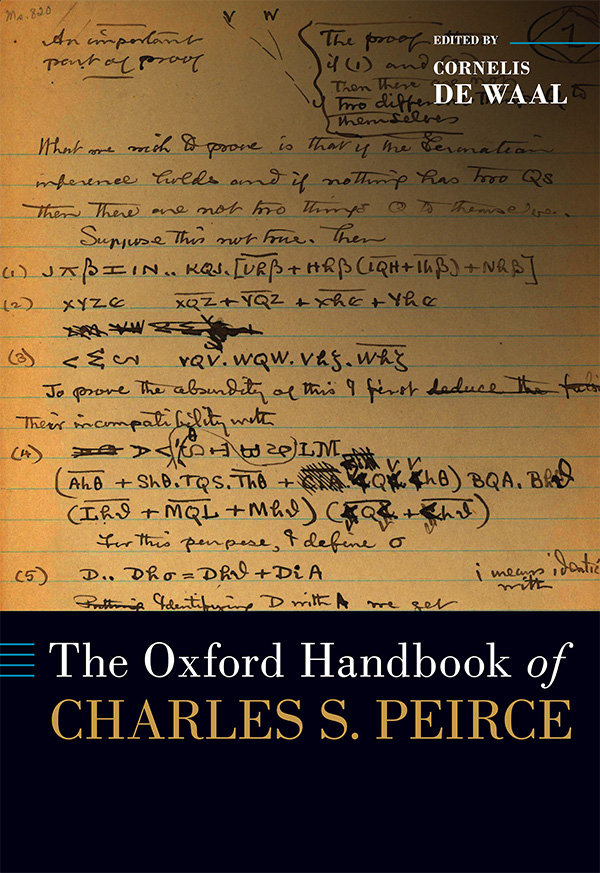
The Oxford Handbook of Charles S. Peirce
The vision of Peirce that comes clear in this volume arises from the coherence of his philosophical, logical, and mathematical thought, drawn out by historical as well as recent applications. The significant advance of this handbook is the combination of US and international scholars drawing upon a wide circle of Peirce’s influence and interest. —Roger Ward in The Pluralist

Introducing Pragmatism: A Tool for Rethinking Philosophy
In this complex field this book of Cornelis de Waal is a jewel of clarity, textual precision an intellectual finesse. This book is a must for whoever interested in knowing what pragmatism is, its history, its validity today and its fruitfulness for the culture of the 21st century. In sum, an excellent book, extremely useful for philosophers and general readers.
—Jaime Nubiola, Universidad de Navarra
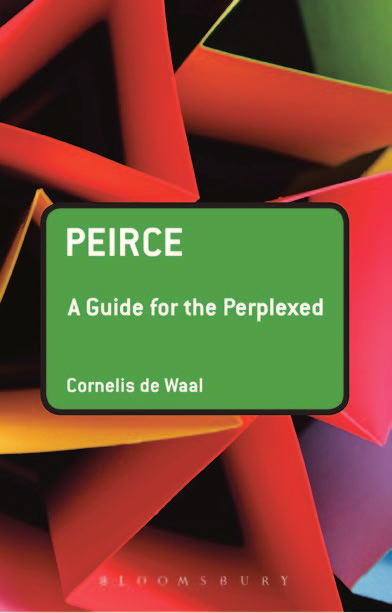
Peirce: A Guide for the Perplexed
Cornelis de Waal’s book is excellent. In fact, it will be hard to do a better job in presenting so much of Peirce’s systematic thought and ambitious theoretical claims in such a small introductory volume.
—Helmut Pape, Otto-Friedrich-Universität Bamberg
Peirce has a new way to think about things and de Waal describes this quite well. ―Jesse Thomas, Journal of Interdisciplinary Studies

Transactions of the Charles S. Peirce Society
Since its founding in 1965, the Transactions is the premier peer-reviewed journal specializing in American philosophy and its history. Though named after the founder of American Pragmatism, all types of American thought are covered from the Colonial period to the present.